
Florence Bloom Bird Sanctuary
The Florence Bloom Bird Sanctuary is located within Delta Park, in Johannesburg. It had its origins in the late 60’s when the Waste Water Treatment Works were finally closed down and parts of the park were developed as Trefoil Park (a girl guide camp), a scout camp and a camp for the Voortrekkers. The local Witwatersrand Bird Club was in the process of having part of the park developed as a bird sanctuary and they approached the Bloom brothers (Harry, Norman and David) to become involved. Florence Bloom, their mother, a nature-lover, died in 1971 and the brothers each donated a bird bath in their mother’s memory to three Johannesburg parks: The Wilds, Melville Koppies and Delta Park. The Witwatersrand Bird Club invited the Blooms to establish a more significant memorial to their mother by assisting with the establishment of what became the Florence Bloom Bird Sanctuary. The 7,5 ha sanctuary was opened in 1975.
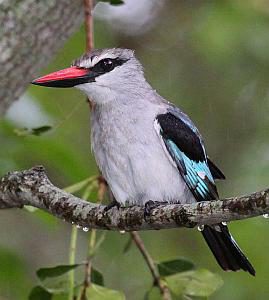
Woodland Kingfisher photographed by Geoff Lockwood
The Florence Bloom Bird Sanctuary is located within Delta Park, in Johannesburg. It had its origins in the late 60’s when the Waste Water Treatment Works were finally closed down and parts of the park were developed as Trefoil Park (a girl guide camp), a scout camp and a camp for the Voortrekkers. The local Witwatersrand Bird Club was in the process of having part of the park developed as a bird sanctuary and they approached the Bloom brothers (Harry, Norman and David) to become involved. Florence Bloom, their mother, a nature-lover, died in 1971 and the brothers each donated a bird bath in their mother’s memory to three Johannesburg parks: The Wilds, Melville Koppies and Delta Park. The Witwatersrand Bird Club invited the Blooms to establish a more significant memorial to their mother by assisting with the establishment of what became the Florence Bloom Bird Sanctuary. The 7,5 ha sanctuary was opened in 1975.
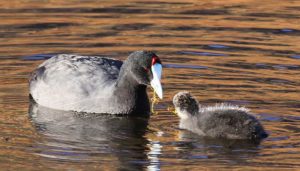
Redknobbed Coot photographed by Geoff Lockwood
The Florence Bloom Bird Sanctuary is home to a surprising number of birds – with the 2 dams attracting various ducks, coots, moorhens and other water birds, as well as the odd kingfisher; the open veld sections attract bishops and weavers, guineafowl and francolin, and the areas of denser bush attract birds such as Willow Warblers, Great Reed-Warblers, and Tawny-flanked Prinias, sparrowhawks and owls. The park also seems to regularly attract highly unusual species and in the past seven years Madagscar Cuckoo, Longtailed Pipit, and Ayres Hawk-Eagle, amongst others, have been recorded.
Other animals also enjoy the safety of the fenced-off sanctuary – mammals such as Striped Mice and even Slender Mongoose and Large Spotted Genet can be found foraging around the park. Reptiles also occur and sightings of Rinkhals and Marsh Terrapin are not uncommon.
The sanctuary is a tranquil oasis less than half an hour from the centre of town and the opportunity that it offers visitors to spend a peaceful few hours enjoying the colour, activity and sounds of the birds as they go about their lives is something that we need to protect.
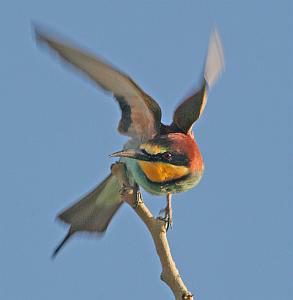
European Bee Eater photographed by Geoff Lockwood
The Birds of Delta Park and the Florence Bloom Bird Sanctuary
I’ve been birding in Delta Park for over 50 years and, in that time, I have recorded over 270 species. Some have since disappeared from the park, and others have been national or regional rarities that are unlikely to be seen here again. There have also been ‘new colonists’ however that appeared in the park and have gone on to become common breeding residents. The first half of 2022 for example has seen three new species – Southern Pochard, Cinnamon-breasted Bunting and Fiery-necked Nightjar being recorded and the checklist keeps growing.
The checklist reflects all the species recorded since 01 January 2002. Most of these records are my own or, in a few cases, those other birders who photographed new or uncommon species in the park and the list is up to date as of mid-July 2022. As the status of any individual species may change dramatically from year to year, I’ve not tried to indicate the status of the species on the list. It will however give a good idea of what is possible.
–Geoff Lockwood